
Herringbone vs. Parquet Flooring: What's the Difference?
Updated: 6 days ago

Parquet is the family of patterned wood floors. Herringbone is one of its best-known patterns.
Planning a project? Talk with Joe Avila: call 908-232-6600 or book a virtual consultation.
People often ask whether they should choose herringbone or parquet, but the two words are not really opposites. Parquet describes a whole family of patterned wood floors, and herringbone is one of the patterns inside that family. Here is how the terms fit together, and what actually matters when you choose a pattern floor.
What Parquet Means

Parquet is a word for wood floors made of smaller pieces laid in a repeating geometric pattern, instead of long boards running in straight rows. The word comes from French, and parquet floors have been laid in grand European homes for centuries. Today the term covers many patterns, from simple squares to detailed panels. When someone says they want a parquet floor, it is worth asking which pattern they have in mind, because two parquet floors can look completely different from each other.
Where Herringbone Fits

Herringbone is one of the most popular parquet patterns. It uses rectangular pieces of the same size, laid at right angles to each other so they form a zigzag, with the end of each piece meeting the side of the next. Because the ends are cut square, the zigzag has a stepped look. So every herringbone floor is a type of parquet pattern, but not every parquet floor is herringbone. That is why herringbone vs. parquet is less a choice between two floors than a choice of pattern within one family.
Other Parquet Patterns

Herringbone has plenty of relatives. Chevron looks similar, but the ends of each piece are cut at an angle so the points meet in a clean, continuous V. Double herringbone pairs two pieces side by side in each step of the zigzag. Basketweave groups short pieces into small squares that alternate direction, like a woven basket. Brick and square or checkerboard patterns are simpler. Panel patterns such as Versailles combine many pieces into large, decorative squares and are among the most formal choices.
Specifying floors for a client or your own home? Book a virtual consultation with Joe Avila.
Parquet Tiles and Block Floors

Many people picture parquet as the square tiles found in older apartments and mid-century homes. These are usually pre-assembled squares of short wood strips, often in a basketweave or square pattern, glued down as one unit. Today's pattern floors are more often laid one piece at a time from individual blocks or planks, which allows tighter layouts, wider pieces and more patterns to choose from. If you have old parquet tiles, they can often be sanded and refinished rather than replaced.
Block Herringbone vs. Plank Herringbone
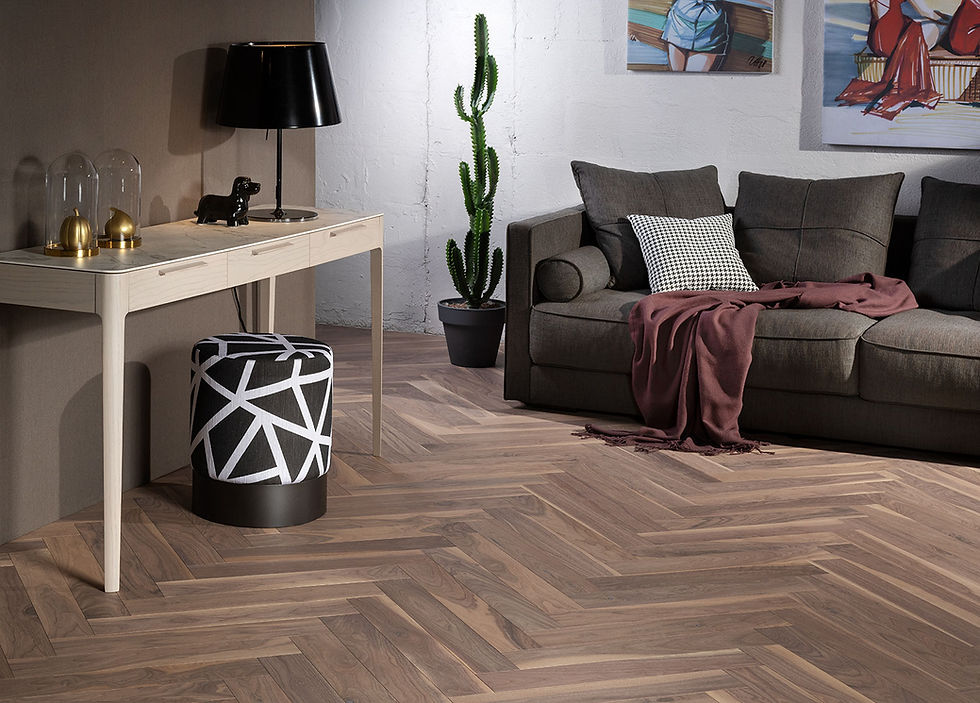
Traditional parquet herringbone uses small, short blocks, which create a tight, busy pattern with lots of movement. Many modern herringbone floors use longer and wider planks instead, which gives a bolder, calmer look that suits open plans and larger rooms. The ratio of length to width changes how the zigzag reads, so the same species can look very different in two sizes. Look at full-size samples laid out together, and think about the size of the room before you decide.
Solid or Engineered Pattern Pieces

Herringbone and other parquet patterns are available in both solid wood and engineered construction. Solid pieces are one piece of wood all the way through and can be sanded many times over their life. Engineered pieces have a real wood top layer over a stable core, which makes them a strong choice over concrete slabs and radiant heat, as well as in apartments. Either way, pattern pieces must be milled accurately so the layout stays tight across the whole room, and the installation method depends on your subfloor.
Have a question about your own floor? Joe Avila can walk you through it.
How to Choose a Pattern Floor

Start with the look you want, then think about the room. Larger rooms can carry bigger pieces and bolder patterns, while small rooms may suit a finer pattern. Consider which way the light falls and where the pattern will start, because a good layout plan keeps the design centered and balanced. Pattern floors take more labor and more waste allowance than straight-laid boards, so plan for that early. A specialist can help you compare patterns, sizes and construction for your space.
Quick Answers
Is herringbone a type of parquet?
Yes. Parquet is the family of wood floors laid in geometric patterns, and herringbone is one of its most popular patterns, along with chevron, basketweave and Versailles.
What is the difference between herringbone and parquet?
Parquet is the general term for patterned wood floors. Herringbone is a specific pattern in which rectangular pieces meet at right angles to form a stepped zigzag.
Is parquet the same as parquet tile?
Not always. Parquet tiles are pre-assembled squares glued down as one unit. Many parquet floors today are laid one piece at a time from individual blocks or planks.
Is herringbone flooring more expensive than plank flooring?
Usually, yes. Pattern pieces must be milled accurately and laid one at a time, and patterns need a larger waste allowance than straight-laid floors.
Talk to a Wood Flooring Specialist
Not sure which option fits your project? Call 908-232-6600 (Monday to Friday, 9 a.m. to 6 p.m. Eastern), visit our showroom at 406B West Broad Street in Westfield, New Jersey, or book a virtual consultation. We work with homeowners, architects and designers across New Jersey, New York City and the East Coast, and serve clients nationwide.
Call 908-232-6600, email joe@hugginsflooring.com or book a virtual consultation. Explore our sanding and finishing, eco-friendly finishes and floor care services.
About The Author
Joe Avila has 26 years in the wood flooring trade. He is an NWFA-certified wood flooring inspector, installer and sander, and for more than a decade he has taught accredited continuing-education programs for AIA, ASID and IDCEC audiences, training thousands of architects and design professionals in how to specify wood flooring correctly.


Comments